Over the summer, I realized I had some alpha, at least over the average American: AI is going to change things way more and way faster than people think (if they are thinking about that at all). Obviously, if you have some informational alpha, you want to turn that into real outcomes so I asked Claude to make me an “AI” portfolio highly leveraged on this thesis. It bought most “AI infra” stocks- semi conductors, RAM, neoclouds and power / materials.
I then proceeded to lose 3% over the next few months while the S&P rose 1% (though this is obviously a very short time frame for what is a long-term thesis), but it made me reconsider.
Ethan Niser on X: seeing your big brained portfolio was outperformed by the sp500 (the simplest investment of all time) has to be in the top 10 most humbling moments in life
View post on X
The outcome of this was that recently I sold every single stock I owned (even ones I owned before the Claude “AI” rebalance) for index funds following the S&P 500 and NASDAQ. The remainder of this post will be my rationale for why.
Why
It started with me re-evaluating the alpha I thought I had. “AI is going to change things way more and way faster than people think” is an extremely general statement, and so any decisions derived from it are likely to be quite general as well. But my stock picks were not general at all- they were extremely concentrated into a single sector: “AI Tech”. Even if you get every layer of the so-called “AI Stack” you are still actually barely diversified at all. Now, this isn’t necessarily the worst thing. These stocks will probably do well, especially if AI takes the transformative course I think it will (and is). But again, go back to the general thesis: “AI will transform the entire economy and world in ways people are not expecting”. That is wayyyyyy bigger than just AI infra. It seems very reasonable to me that many of the biggest “winners” to come out of the AI era will not be “AI stocks” as we usually bucket them right now, but very unassuming companies or industries that will be transformed in hard-to-predict ways. This tweet captured this sentiment well:
Boring_Business on X: After fridges became a common household appliance, the biggest benefactor was not the manufacturer companies. It was actually Coca-Cola, who took advantage of the new technology to shift from local soda fountains to bottled and canned products Suspect the same will be true for… pic.twitter.com/WSYUNC0Fiq
View post on X
As did this article aptly called “AI Will Not Make You Rich”. It examines other major infrastructure buildouts such as railroads and the internet, both of which enabled immense growth for lots of companies or industries that built never-before-possible businesses on top of new infrastructure, but often the people who built that infrastructure saw far fewer spoils. Additionally, infrastructure companies are highly constrained by physical and capital limits which set a ceiling for their growth, compared to other types of higher-level businesses.
If that’s true, I think it’s possible to have the right informational advantage that AI will be very impactful and be more impactful very quickly, and still miss out on a huge portion of the wealth created as a result of this if you only invest in the current “AI Stocks”.
As an example, I had a friend tell me about one of their big lab employee friends who had crazy quick AI timelines (much, much more than mine- I wonder what he knows…) who put most of his savings into one ETF, $ATF, the “VistaShares Artificial Intelligence Supercycle ETF”. Sounds great, right? Until you look at the holdings:
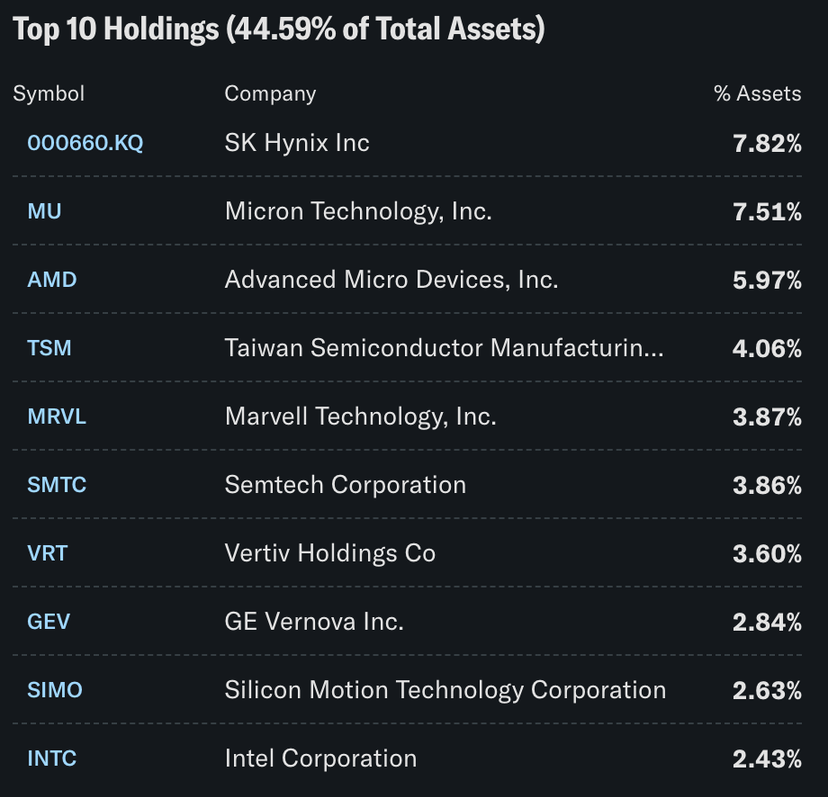
How did all of “Artificial Intelligence” become RAM and semis? Because that’s all this ETF is. AI is a universal technology. It (in theory) accelerates everything in unpredictable ways. Why would you invest in just one tiny slim sector, and one that’s capitally and physically constrained in so many ways?
So how do you avoid this? Well, you can try to pick industries you think will be transformed by AI in advance, and try to spot rising new categories early. But there’s just one problem: this is insanely fucking hard. Not only is it hard, but it’s risky because the opportunity cost is insane. You are giving up an essentially guaranteed huge ride on the sweet sweet beta wave.
And this is where we talk about index funds. They are amazing because they are so stupid and yet so smart. Let me explain.
Right now we are considering a few things:
- AI is going to transform the economy
- AI “infra” companies will be some of this but so will many other hard-to-predict sectors (and surely many new ones hard to imagine at this point)
- Many current companies may not adapt well and decline
- We want to capture as much of the upside as possible with as little risk as possible
Guys, just buying the S&P checks every box. I’m serious. Economy improves = you win! Old companies that die? S&P just drops them. Amazing new companies come up? S&P adds them! How much thinking or quant-level predicting do you have to do? Zero!
Are you missing out on maximum upside? Of course. But guys, let’s be serious. If you really think AI is going to be as crazy as some of these people are saying, you are going to be plenty rich from just buying the S&P, just with as little risk as possible.
In conclusion
I think AI will change the world. I am not smart enough (likely no one else is either) to accurately be able to know where and how that will change the economy specifically. Thankfully, I can buy index funds and still win without having to know any of that, or carry the risk of picking wrong.
But honestly, if you look at the top holdings of these S&P and NASDAQ index funds, they look pretty similar to a lot of these “AI” portfolios anyway… so I guess maybe it doesn’t make a huge difference after all. Though honestly this is even a further argument for index funds since if all of the biggest companies are the same current AI companies then you already hold them and will keep holding them. And only if things change then you automatically get the new best companies with zero management!
Anyways happy to discuss this one out in the comments and I look forward to being brutally made fun of for this if I am terribly wrong in 10 years.