“Become fluent in 6 months”
“Pay off the house on one 10-leg parlay”
“Get shredded in weeks with this supplement”
In recent years, rapidly lowering attention spans, combined with wider exposure to previously rarely seen extremes, have created an environment filled with content and advertisements just like this, across essentially every category.
We all know how it works out. Either the goal is simply not obtainable for most people, or requires such enormous effort that 99% of people will crash and burn out before they see even a hint of progress.
But things do not have to be this way. In this essay, I will argue for what I call “The Gentle Climb”, an alternative approach to outcome reaching and skill building.
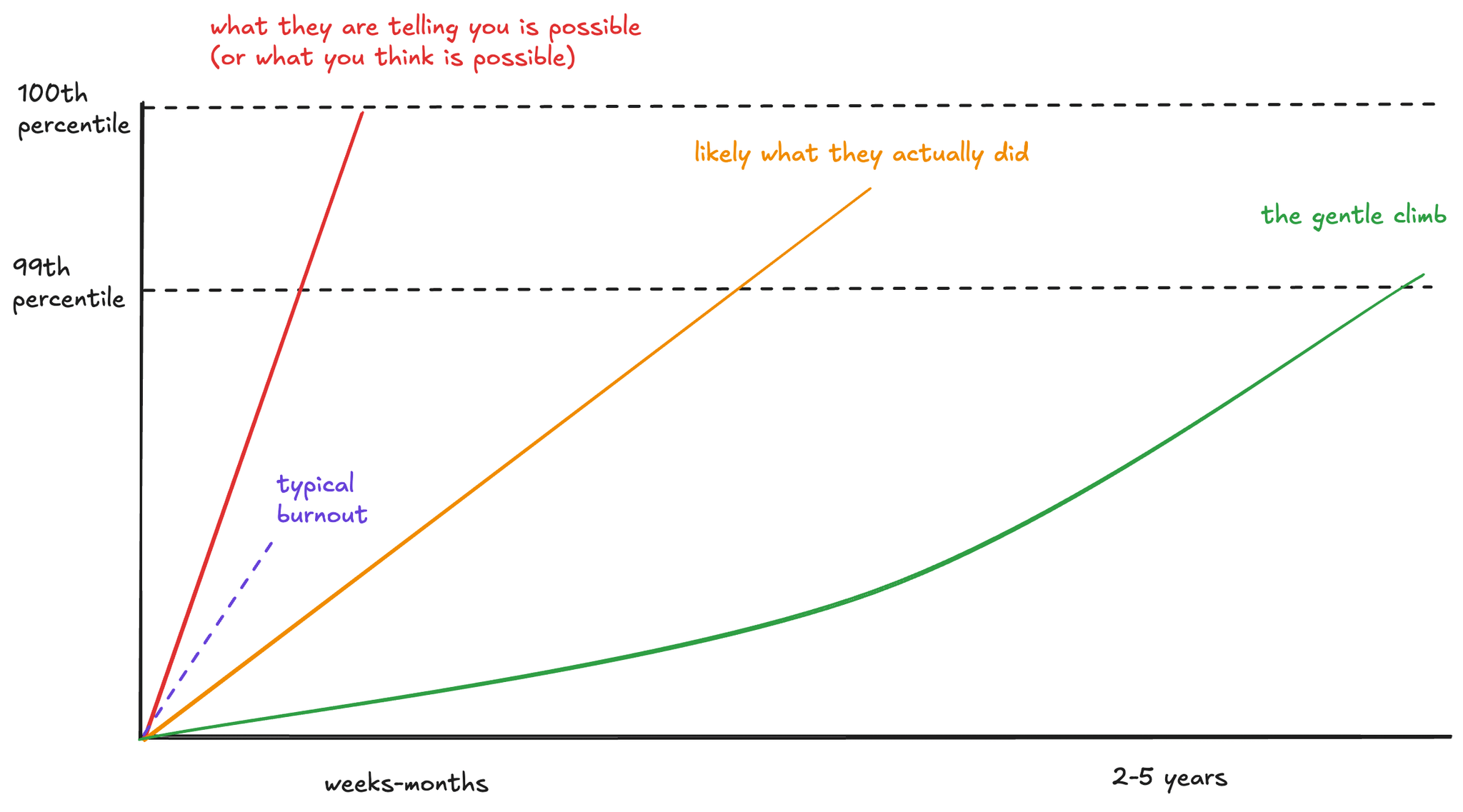
The Gentle Climb is very simple. It’s doing something around an hour a day for 2-5 years to reach approximately the 99th percentile in anything. That is it- seriously.
But within that simplicity is a fundamentally different way of looking at two core things: expectations and action. I will discuss each of those, then why The Gentle Climb’s combination is particularly effective. Finally, I will discuss scenarios where The Gentle Climb might not be best.
Expectations
Most people have no fucking idea what they want. They might think they know what they want. Often this is highly influenced by what they see other people have, but these estimates are typically inaccurate.
Why is this the case? As mentioned earlier, as a result of the rise of the internet and social media, we are now exposed to truly extraordinary things so regularly it shifts our perceptions to the extremes.
However, I think for most people, for most things, reaching a far lower (yet still high) level would actually lead to a lot of satisfaction. Imagine being better at something than all of your friends and coworkers, probably their friends and coworkers too. If you don’t live in a big city, you could easily be the best at that thing in the entire town. Sounds pretty nice, right? You can achieve that by being in the top 1%. Still a far cry from the top 1% of the 1% but remember, you are better than everyone you know and everyone they know (or at least everyone you knew before you started the thing). I don’t say this to imply that satisfaction comes from only being better than other people, but rather to just to help calibrate your scales for yourself. If you reach this level, you’re probably pretty good at the thing and can then reap the rewards of that.
Because of the exponentially increasing effort it takes to reach the actual extremes, by simply accepting a lower but still high bar you cut the amount of effort it takes to reach your goal by orders of magnitude. This means you no longer need to dedicate your entire life, or have freakish genetics, or sacrifice your health. Instead, with reasonable, consistent action, reaching this level in almost anything becomes achievable.
Action
You are going to have to put in some effort if you want results, there is no way around this. The issue is most people overestimate how effective extreme lifestyle changes and “locking in” are, and greatly underestimate how effective compounding over time is.
I imagine it’s a universal experience to feel shitty about something, announce to yourself “I’ve had enough. I’m going to <take x extreme actions>”, only to quickly abandon them. Navigating extreme changes based on willpower alone is not easy. It also isn’t very effective. Results (even if going well) often come slower than anticipated, and failing to live up to the impossible standard you set makes it feel like “it’s so over” and “what’s even the point”.
So what to do instead? Spend about an hour a day on the thing. For as many days as you can, the more the better. Don’t think about streaks- instead, just focus on keeping your moving average high, and ideally going up over time. An hour is the perfect unit of time where you can actually get settled and focused for a bit without anxiously knowing the time will be over soon, while still being reasonably short so it doesn’t feel impossible.
Two orders of magnitude
Why does The Gentle Climb work? Imagine skill building or outcome achieving as requiring a certain number of “points” to reach any given goal. The Gentle Climb first lowers the required points by an order of magnitude by lowering the bar from the 99.99th percentile to simply the 99th percentile. Then it increases the points you “gain” by another order of magnitude by making the daily effort achievable so you actually do it, spreading the time frame out by years so you do it a lot, and taking advantage of compounding over time.
When not to use The Gentle Climb
I don’t think one should apply The Gentle Climb to everything. It is a very unique and special thing to not just be “really good” but to be “the best”. This is excellence. Excellence is good, and you should pursue it if you desire.
However, not everything needs to be this way. Many people who strive for excellence in some aspects of their life apply this standard to other, still important but less crucial things. Since trying to hold all of these things to such a high bar is either unsustainable or impossible, they often leave those other things in a bad state. The Gentle Climb excels here by providing the biggest “bang for your buck” for important “side projects” like hobbies or personal fitness.
The Gentle Climb can also be a very valid path to excellence, even if it is explicitly not your initial goal. Many people who reach the 99th percentile soon find the desire to push further, which they absolutely should do if they want to. The Gentle Climb gets you to that point with less of a chance of burning out compared to going all in from the start, as well as giving you the benefit of “short circuiting” early with less invested if you realize something isn’t for you.
Me
I have a personal hobby I followed The Gentle Climb for, though not intentionally. The whole time, I saw myself as continuously failing to live up to the standard I set based on others online, but I kept doing it at around an average of an hour per day for around 3 years.
And at the end, it all worked out. I was better than anyone else I knew before I started. I felt really good and had a lot of fun. I could’ve spent the exact same amount of effort, just without the stress of feeling like I was failing the entire time, and had the same outcome. It took a lot of time to detach my own goal from those I saw online and actually realize that I was satisfied with just being 99th percentile and not 99.99th. But having gone through this, I hope to apply this strategy to other parts of my life, chiefly personal fitness, which I had gotten into in high school before spectacularly burning out. Since that time, my brother, who never tracked calories or what exercises he would do, went from being a very slim track athlete to looking really strong in the years I was doing nothing because I quit.