The coffee at The Coffee Movement is excellent. It is really, seriously delicious. The flavor of the coffee, the texture and temperature1 of the milk, the seasonal syrups. I love The Coffee Movement.
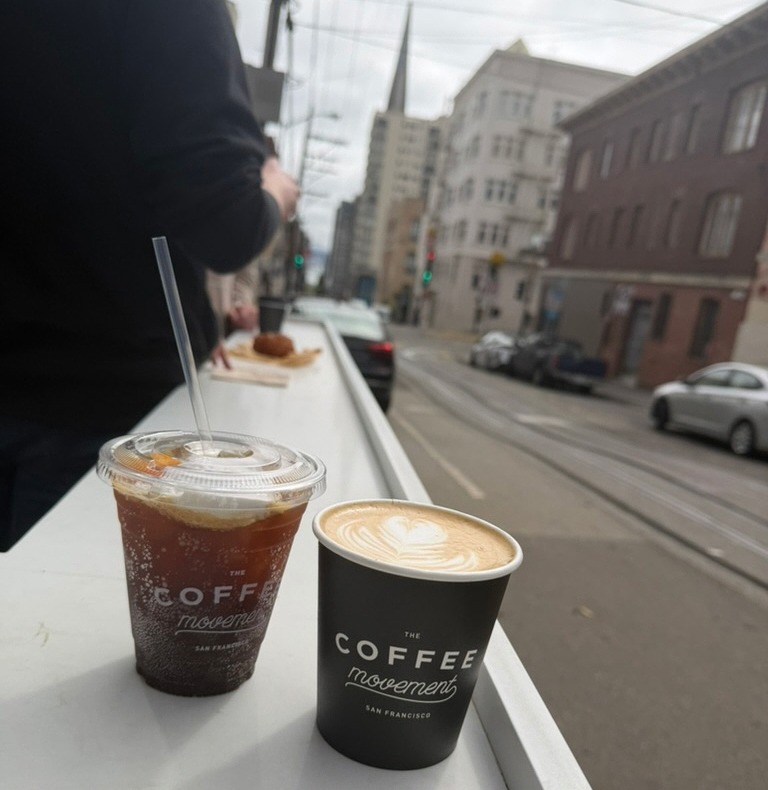
And yet the coffee is not at all why I think it is the best coffee shop in San Francisco. There are other coffee shops with really good coffee2. So what is it about The Coffee Movement that is so exceptional? The design.
When I say design, I don’t mean the visual design of the coffee cups, though they are aesthetically pleasing. I mean the design of the entire experience of the user, a patron. The way it feels to arrive at the shop, to wait in line, to order and pay, and finally drink your coffee. Whether done intentionally or not, I believe the design of The Coffee Movement exceeds that of other coffee shops in a multitude of ways.
In this essay I will define a framework describing each of the stages involved in being a patron of a coffee shop, chiefly without invoking the quality of the coffee served. Then I will present the experience of being a patron at The Coffee Movement, as well as two other boutique coffee shops in San Francisco, Golden Goat and Saint Frank. Then, I will compare these experiences through the lens of the previously established framework. Finally, I will derive a set of lessons that can be learned from The Coffee Movement’s praiseworthy design.
A framework for assessing coffee shop experiences
The core experience of a coffee shop patron follows this general pattern: arrival, waiting, ordering, waiting (part 2), and consuming. I will now provide a brief explanation of each step in this pattern.
1. Arrival
To patronize a coffee shop, you must first arrive at it and enter into its customer flow3. As you approach its location, typically on foot, you see its storefront and decor. You must assess important information about the state of the coffee shop, such as the current number and location of other patrons (whether consuming or waiting), and how busy the baristas are. Then you must find and place yourself in line.
2. Waiting
In a world with finite supply, it is sometimes necessary to wait in line. Waiting has many aspects beyond simply how long you must wait (though this often dominates people’s thoughts about a given wait). First you must find where you are supposed to wait, then you may need to actively move to stay in line as it progresses. Lines can move fast or slow, be organized or disorganized, twist and turn or be held in place with physical restraints. In this phase you specifically wait for your turn to place your order. As such, it may be advantageous to view the menu (if provided) during this phase to give you ample time to decide prior to ordering.
3. Ordering
Ordering is at its core a conversation defined by two core components: a choice and a request. Your partner in conversation can range from a cold, faceless kiosk to a human barista, friendly or disengaged. First comes choice. From the various options on the menu, you must choose what you will request. The menu may be large or small, varied or similar, detailed or vague. Your order may be standard or require customization. While mostly internal, this can be part of the conversation where you receive advice or recommendations. Next you must submit your request, communicate your order and conclude the conversation. You may be required to submit payment for your order at this time, or it can be deferred until you receive your order.
4. Waiting (part 2)
After you submit your order, your coffee will be prepared. This can take a long time, or no time at all. While most of the same factors as waiting (part 1) apply, this stage can often be more chaotic as orders placed after another order may be completed first, supporting disorganization. You may wait in a separate standing line, or sit down at a table. At the conclusion of waiting, you must physically receive your coffee, which is also a part of this stage. Where and how you receive your coffee, and how you know it is your turn to receive it are all components of this stage.
5. Consumption
Finally, the moment you came to the coffee shop for: drinking your coffee. Drinking is not done in isolation, however; location plays a key role, whether inside at a table, outside at a provided bench, or in a separate location altogether. How the coffee is presented: whether in a mug, glass, or paper to-go cup. Is it busy or crowded? Quiet or loud? Please note that for the scope of this essay this stage will not involve an assessment of the quality of the coffee itself.
A description of the experience at 3 coffee shops
The Coffee Movement
The Coffee Movement (Chinatown location) is located at 1030 Washington St, a small little shop poking out of a street of otherwise all houses. The street itself is highly inclined and has a cable car track running through it. As you approach the store, you will immediately see the queue forming to the west, with the consumption area across the sidewalk to the south. The line has a small physical divider set up to the left of the door, with a bench to the right, naturally seeding both the location and direction of the queue west along the houses up the sidewalk, as well as making it clear where to join at the end. Despite its often impressive length, the line at The Coffee Movement is straight and organized, and avoids blocking passing pedestrians. I also find that the line feels like it moves pretty fast, though whether this is due to its narrowness, or its actual speed, or maybe a combination of both, I can’t say for certain. The short physical divider near the door displays the menu (which is quite simple), giving you time to decide prior to ordering. It also displays what is, in my opinion, the most important part of The Coffee Movement’s design: a sign stating that patrons must not move past the front of the queue (which is again fully outside of the building) and into the building until it is their turn. This critical choice means that when you enter into the store, for a brief moment it is effectively your own private coffee shop. There is no one else inside (except maybe the preceding customer who is wrapping up payment or on the way out), and the baristas give you their full, undivided attention.
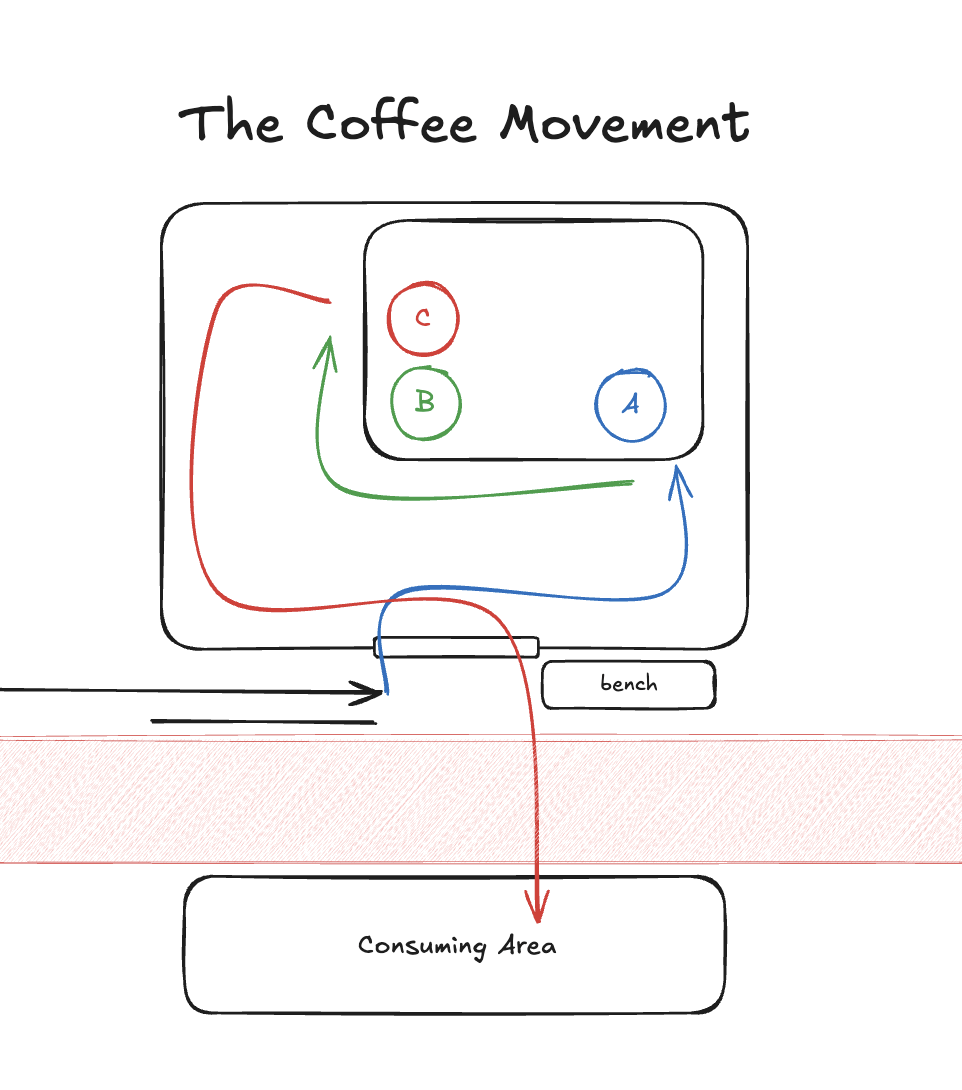
During busy periods, The Coffee Movement typically has 3-4 baristas working in this configuration. Barista A is who you will interact with the longest, and is who you can ask questions and eventually give your order to. While talking to you, Barista A is filling up pucks and pulling shots. When your order is in, you’ll be asked to step around the corner to pay. At the counter you interact with Barista C who is responsible for ringing you up. If you want a pastry, you can pick from the case next to the register and receive it immediately. While this is happening, your espresso and order are passed off down the line to Barista B who is now pouring your latte. What this means is that by the time you’ve finished paying (and going through the 20 post-payment prompts kiosks have nowadays) your drink is already in front of you, alongside a lid on a plate next to it4. You take your card out, grab your drink and walk outside. From entrance to exit, it usually takes under two minutes. Outside you can either take your coffee to go, or stand at the counters set up where a car would usually park next to the street to drink. I’ve never not been able to find a spot to stand here (likely because so many people do to-go, and waiting is not done here). The view down the hill is beautiful and you can wave at tourists on the cable car as they go by.
Saint Frank
Saint Frank (Mira Location) is located at 120 Folsom St. Approaching the store, you enter through a set of double doors. There is often a line at busy times. It usually branches to the east along the building, though I have seen it snake out south toward the street when the line is more newly formed and people continue the direction of the line inside towards the counter out into the sidewalk.
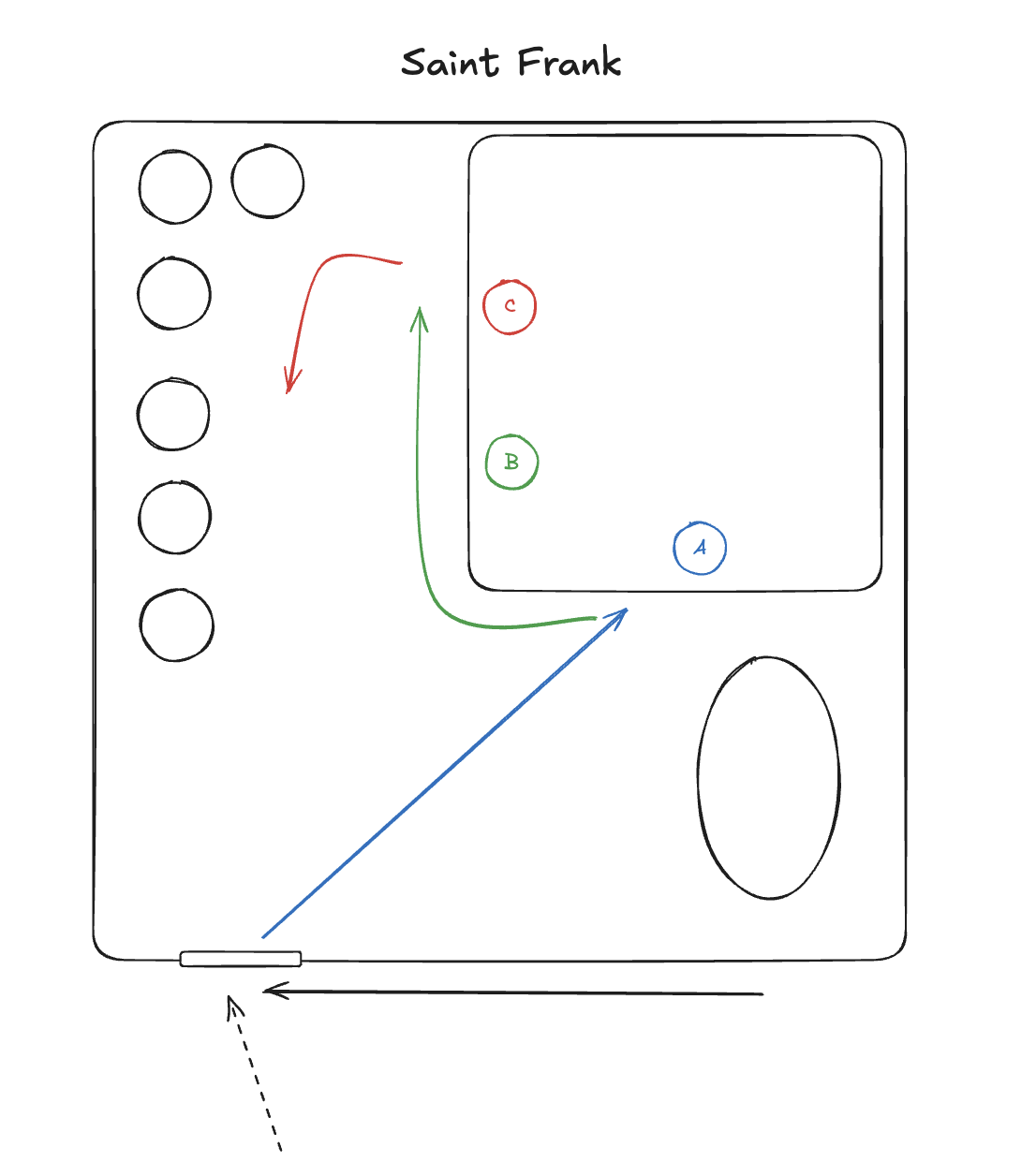
The menu is on the window right outside the door, but otherwise not visible inside till you are at the very front of the line. The line goes all the way up until the counter where you place your order with the barista there. The baristas are placed in a similar configuration to those at The Coffee Movement, where most of the communication happens with Barista A while they grind and fill pucks, then payment with Barista C, while Barista B prepares the final drinks. Pastries are displayed in a case in front of Barista A, but are stored to the left of Barista C, leading to times where you “order” a pastry with Barista A, but really that order must be given to Barista C. While there are times my drink is ready right after ordering, I typically find that there is about one customer waiting off to the left or behind the customer currently checking out for their drink. When you get your drink, you either walk alongside the line to exit or choose a seat. There are tables along the wall across from the counter and a standing counter (that I have never seen anyone use) near the door on the left. If you go through the standing line, there are some chairs to the right of the door, and past them, a single, larger table. I find the inside often fairly loud, and the line running through the center of the shop closes off what is otherwise quite a large space.
Golden Goat
Golden Goat Coffee is located at 599 3rd St, and is truly a “hole in the wall” coffee shop, though very popular. You approach from the alley entrance to see the shop with a narrow entrance with benches to each side. The line is often disorganized, and can easily be confused with already-ordered waiting patrons. I also personally find that the line moves relatively slowly. After waiting, you reach the counter and give your order to the barista in front of the kiosk, pay up front, and give your name.
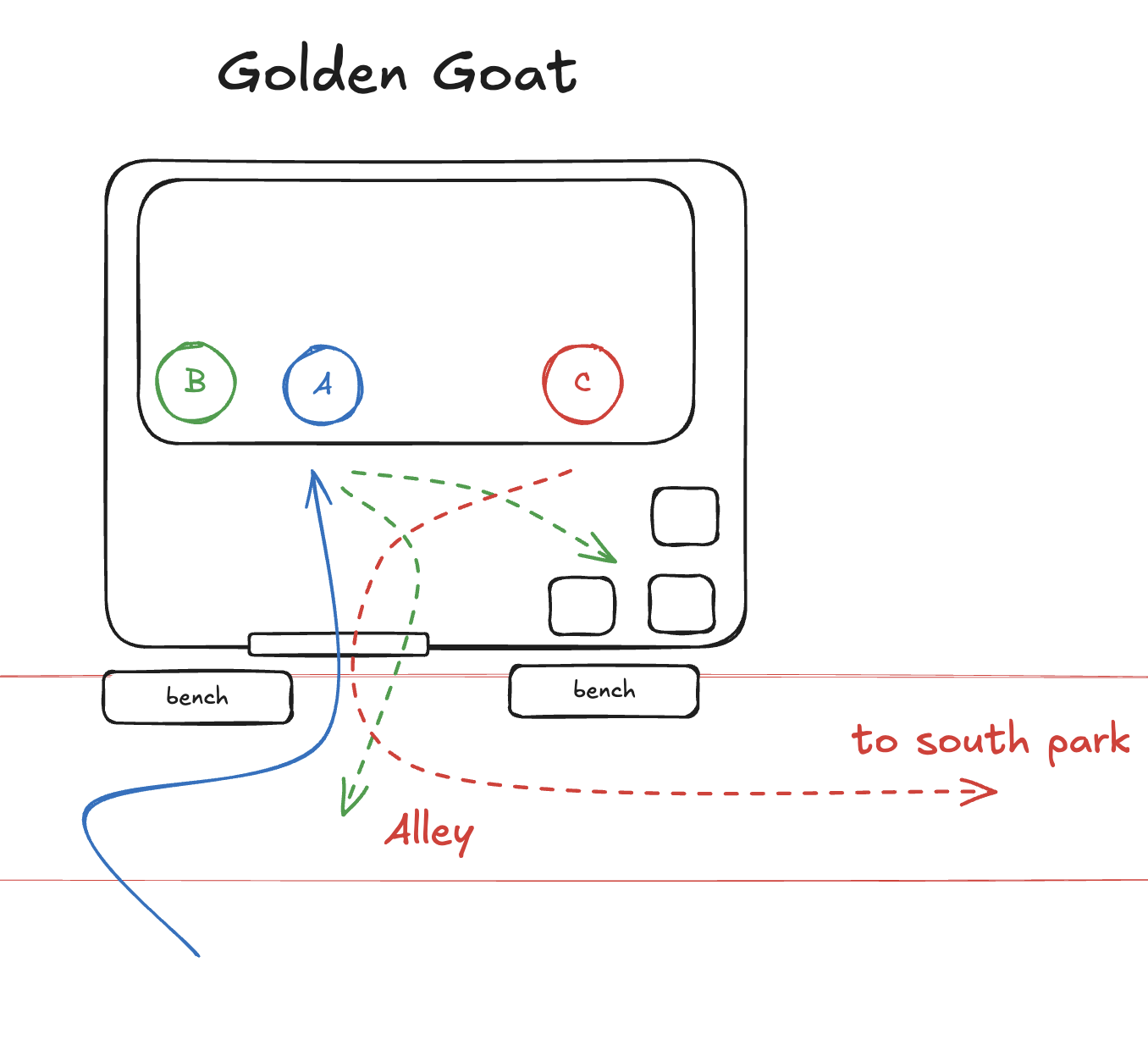
This barista typically only takes orders and does finishing touches, while two baristas to the left make the drinks. You pick from the pastry case to the right of the kiosk, and receive your pastry with your coffee when it comes out. You then wait for your coffee to come out, which often takes just as long as the initial line. You can sit on some chairs inside (though it is quite tight), sit on the benches outside, or simply stand outside (this is where the line confusion comes from). After your coffee is ready, your name is called, and you pick up your coffee at the counter on the very right. If you can’t hear (because you are outside in the alley), your coffee is left at the pickup counter on the far right. After you get your coffee, there are no designated consumption areas, and the benches are usually taken by people waiting. If you are not taking your coffee to go, it is customary to walk only a block to the nearby South Park to consume your coffee.
A comparison of coffee shop experiences
1. Arrival
Arriving at Golden Goat is often chaotic and unstructured. It is not always clear who is in line or where the line ends, because people waiting to order and people waiting for their drinks occupy the same space. Saint Frank has a more organized line from the door to the counter, though its direction outside can vary as people join it. The Coffee Movement has the clearest arrangement: the line is fully outside, straight, and consistently extends in the same direction. Before joining, you can see where you belong and what you are signing up for.
2. Waiting
The Coffee Movement often has a long line, but I find it surprisingly painless to wait in. It is organized, feels like it moves quickly, and gives you a chance to read the menu before your turn. Saint Frank’s line usually feels somewhere in the middle, but the menu is difficult to see while waiting inside, and the queue runs through the shop’s seating area. Golden Goat’s line feels slower, with the added uncertainty of distinguishing the people waiting to order from those waiting for drinks.
3. Ordering
Ordering is where The Coffee Movement’s decision to keep the queue outside really pays off. Once you enter, you have the baristas’ attention without a line of customers standing immediately behind you. You can ask a question or have a brief conversation, and for that moment it feels like your own coffee shop. Saint Frank has a similar workflow between ordering, preparation, and payment, but you remain surrounded by the queue and the activity of the larger shop. Golden Goat has a straightforward order-and-pay interaction at the register.
4. Waiting (part 2)
At The Coffee Movement, the second wait effectively disappears into ordering and payment. Your drink is being made while you talk to the baristas and pay, so by the time you finish, it is usually ready to take with you. Saint Frank often achieves something similar, though I sometimes have a short wait after paying. At Golden Goat, ordering leads to a separate wait that can feel just as long as the first, with the added need to listen for your name or check the pickup counter.
5. Consumption
The Coffee Movement’s outdoor standing area gives people drinking their coffee a space separate from those still waiting. I can usually find a spot, enjoy the view down the hill, and watch the cable cars pass. Saint Frank offers something The Coffee Movement does not: indoor tables where you can sit with your drink. But the line running through the shop makes that space feel busier and more intrusive than its size might suggest. At Golden Goat, the benches and chairs are often occupied by people waiting for orders, so I usually take my coffee away, sometimes to nearby South Park.
Lessons that can be drawn
1. How you define space encompasses all decisions inside it
Drawing lines preempts all that takes place inside those lines, meaning they have major consequences. For example, the way the Saint Frank store is set up, with the door and counter in the positions they are in, makes it impossible for the line (or customer flow if there is no line or if the line is kept fully outside) not to cut through the middle of the seating space. At Golden Goat, the register being between the espresso machine and the pickup space means the linear order -> pickup flow found at The Coffee Movement and Saint Frank is not possible, likely leading to the deferred order design chosen. This lesson applies to non-physical spaces as well. In software, the digital spaces you choose (for example, a programming language or framework) determine your future options inside those walls.
2. If you must have a bad part, try to keep it unseparated, at the beginning, and as far away from the good part as possible.
I don’t mind waiting if, when it’s my turn, I know it’s all smooth sailing from there. I find the second wait at Golden Goat to be by far the most agonizing. It reminds me of theme park rides with a pre-show. Some sprinkle pre-ride experiences throughout the line to keep you interested while you wait, but after each one you’re back to standing still, waiting again. Others make the pre-show feel like the beginning of the ride itself: once you reach it, there’s little standing still left, and you no longer see crowds of other guests waiting around you. I prefer those because once I reach that point, I feel like I can finally relax and enjoy the experience, knowing the waiting is behind me.
3. The way space is used can often be more important than how much you have
The Coffee Movement is very, very small. I would say about the same size as Golden Goat. But I never feel like it’s crowded inside, unlike Golden Goat which often feels that way.
4. Making a universal experience feel personal, even if just for a moment is valuable
On a given morning, The Coffee Movement probably serves hundreds of guests, but when you walk through the door it really feels like it’s your coffee shop. I love the conversations I have with the baristas, and I don’t feel rushed. I really enjoy that time even if it’s mostly an illusion.
Conclusion
I love all of these coffee shops and patronize them regularly. This essay should not be interpreted as putting any down, as much as highlighting where I think The Coffee Movement really excels. Have different opinions? Amazing, let me know.
Footnotes
-
Burning my tongue is a massive pet peeve of mine. I was so used to having my tongue burnt before I started going to The Coffee Movement regularly. They always serve the coffee at the perfect drinking temperature right when they serve it to you- what a concept! ↩
-
The Saint Frank competition cappuccino is also truly excellent ↩
-
Yes, technically you can order delivery. Boutique coffee shops such as the ones I am analyzing in this essay tend not to offer delivery, so I will leave such “online arrivals” out of scope. ↩
-
Not much significance to this, but I’ve never seen another cafe do it. ↩